Wind Turbine Manufacturing: How Equipment Makers Build a Business
Wind turbine manufacturing is the industrial business of designing, fabricating, assembling, testing and supporting equipment used to generate electricity from wind. It is distinct from owning a wind farm. Centiki Wind Turbines is a fictional manufacturer that demonstrates real decisions about factories, supplier contracts, engineering, product reliability and the cash required to deliver expensive equipment.
Who buys the equipment?
Wind developers, utilities and independent power producers invest in generating projects and purchase turbines or large components from manufacturers. A turbine maker may supply complete machines, individual blades, towers or power electronics, or maintenance services. The equipment buyer seeks high energy production, predictable availability, warranty protection and reliable delivery. The original-equipment manufacturer (OEM) must meet those requirements at a price that covers its own complex industrial costs.
The U.S. Department of Energy’s wind manufacturing overview describes approximately 8,000 parts in a utility-scale wind turbine. Those include blades, hub, nacelle, drivetrain, generator, controls and tower components. These are not 8,000 products a startup must fabricate: an OEM typically integrates a large supplier network. Understanding which parts to make and which to buy is the first major strategic decision.
Choose the position in the supply chain
A new company could manufacture turbine blades, fabricate steel towers, assemble drivetrain components, produce power converters, supply controls or provide inspection and overhaul services. These niches have very different factory investments, transport problems and technical qualifications. A complete turbine OEM faces the greatest integration demands and potentially the highest warranty exposure.
The DOE 2024 Land-Based Wind Market Report reported 6,474 MW of new U.S. land-based wind capacity installed in 2023, with $10.8 billion invested in expansion. It also reported that four turbine makers supplied all U.S. utility-scale wind capacity added that year. Such concentration is a warning about the barriers facing a new entrant; it is not a forecast for a single startup manufacturer.
Engineering: the sale begins long before the machine ships
Wind turbines operate for years under variable loading, temperature, humidity and weather. Manufacturers must design for fatigue, dynamic loads, electrical safety and maintainability. Engineering work includes aerodynamic and structural calculations, drivetrain design, controls, materials selection, monitoring, and tests to validate the design. Each new platform can require substantial development before the first commercial order.
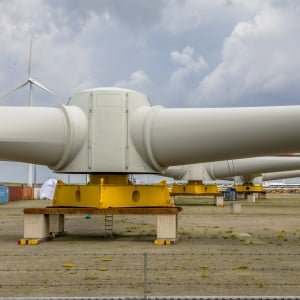
Manufacturing also involves tooling and quality assurance. A blade requires a large mold, composite material layup, curing, inspection and repair processes. A tower uses heavy plate forming, welding, coatings and dimensional testing. Generators and converters depend on electrical components and complex factory quality control. A failure in one small part can create expensive downtime for the turbine owner and a warranty liability for the manufacturer.
Transportation, installation and after-sales commitments
Large blades and tower sections can be costly to transport. Road geometry, bridge limits, permits, specialist trailers and site access may constrain design and delivery. Manufacturers must decide whether their contract includes transport, commissioning and field service. A customer may demand liquidated damages for late delivery or performance shortfalls. Pricing without these contract obligations can destroy a bid’s apparent margin.
Service agreements can generate recurring revenue from inspections, replacement components, condition monitoring and repairs. But long-term service commitments require spare-parts inventories, technical personnel and careful estimates of future failure rates. Suppliers who overpromise availability can carry losses for years after the original sale.
Manufacturing scale and research evidence
Lawrence Berkeley National Laboratory’s 2025 Land-Based Wind Energy Technology Update brings together empirical U.S. data on installation, performance, technology and cost trends. Its datasets provide a more appropriate starting point for equipment analysis than the profit margins of unrelated consumer industries. Because equipment designs and project conditions vary, one should never take a national project cost and treat it as the selling price or cost of manufacturing a turbine.
The DOE overview notes that a collaborative blade-manufacturing demonstration reduced a particular blade production process from about 38 hours to 24 hours, or roughly 37%. This documents an improvement in that process, not a universal productivity rate for all blade factories. Manufacturers need measured cycle times, rejection rates, material consumption and labor productivity for their own specific lines.
Commercial contracts and financing
Project orders may be very large relative to the manufacturer’s balance sheet. Contract terms determine whether the buyer pays deposits, progress payments or only after delivery. The factory may need to finance materials and wages long before collecting the final amount. Performance bonds, warranties, parent guarantees and insurance may be required. See Capital, Equity, and Commercial Borrowing for financing options and Cash Flow, Working Capital, and Bankruptcy for the danger of growth without liquidity.
Supplier concentration creates additional risk. A late generator, bearing or converter can halt final assembly. Inventory buffers reduce this exposure but consume cash. The company should qualify suppliers, inspect incoming components, maintain traceability and avoid designing a product that depends on a single unavailable item.
Worked example: a hypothetical tower-fabrication supplier
A startup that fabricates steel tower sections offers a simpler example than a complete turbine OEM. Suppose it delivers 12 tower-section orders per month at $160,000 each. Assume steel and purchased inputs cost $92,000 per order, direct production labor and variable services cost $30,000, and fixed manufacturing overhead and administration are $300,000 monthly. These are fictional assumptions, not a quotation or benchmark for tower manufacturing.
| Monthly calculation | Illustrative amount |
| Completed orders | 12 |
| Revenue: 12 × $160,000 | $1,920,000 |
| Materials: 12 × $92,000 | $1,104,000 |
| Direct variable production: 12 × $30,000 | $360,000 |
| Contribution before fixed overhead | $456,000 |
| Fixed factory and administrative costs | $300,000 |
| Operating surplus before tax, financing and capital charges | $156,000 |
Hypothetical teaching example; not a reported industry average.
Contribution is $38,000 per order, making approximate break-even $300,000 ÷ $38,000 = 7.90, or eight comparable orders per month. At six orders the business loses $72,000 before financing and taxes. At 12 orders the simplified operating surplus is 8.1% of revenue. This excludes one-time tooling investment, depreciation, debt interest, contract penalties and warranty reserves, all of which a real plan must incorporate.
Sensitivity to steel prices and rework
Suppose purchased materials rise by $10,000 per order without a corresponding selling-price increase. Contribution falls to $28,000; break-even becomes 10.72 orders, meaning at least 11 deliveries rather than eight. At 12 orders the operating surplus shrinks to $36,000. A rejection or rework episode can be equally damaging. The company needs purchase commitments, escalation clauses where negotiable and quality controls tied to the financial model.
Building a practical market-entry plan
A viable plan specifies the product family, customers, required certificates, engineering and tooling, factory capacity, logistics routes, supplier quotations, lead times and payment schedules. It should compare outsourced fabrication with an owned factory and evaluate whether an early entrant has a defendable advantage in cost, location, technology or service.
- Choose a niche: blades, towers, nacelles, controls, spare parts or full-system integration.
- Obtain real customer specifications and supplier quotations before estimating margins.
- Budget design validation, testing, warranties and product liability.
- Model working capital for long production and acceptance periods.
- Test sensitivity to material prices, utilization, rework and delayed payments.
A wind-turbine manufacturer earns profit by producing reliable equipment more efficiently than the customer could obtain elsewhere. Engineering achievement is necessary, but disciplined contracts, adequate finance and reliable industrial execution are what make the enterprise commercially durable. Further reading: Business Growth, Valuation, and Investment and Revenue, Expenses, and Profit.
Sources and further reading
- DOE — Wind Manufacturing and Supply Chain
- DOE — 2024 Land-Based Wind Market Report
- Lawrence Berkeley National Laboratory — 2025 Wind Technology Update
- DOE — Wind Testing and Certification
Class dismissed
Business economics is the lesson. To explore a fictional stock exchange where virtual companies, financing and ownership decisions become interactive exercises, visit Centiki Exchange. The ki and shares in the simulation have no monetary value, are non-redeemable, and confer no ownership or profit rights.
The route into the larger Centiki world begins at Centiki.com. The fictional society that grew around its economy is described at State of Felicia. For another serious lesson, return to the Business 101 course index.