Aquaculture Business: How Sea Farming Companies Operate and Earn Money
An aquaculture business cultivates fish, shellfish or other aquatic organisms for sale rather than relying on wild capture. Centiki Sea Farming AIR005 illustrates how a fictional seafood producer could select a species and site, invest in farming equipment, manage biological production and sell harvests. Unlike simple retail enterprises, aquaculture companies hold living inventory whose survival, growth and market value change with time. This guide explains production methods, customers, cash flow, regulation and profitability with figures from USDA and NOAA and a clearly identified hypothetical budget.
A seafood farmer is not the same as a fishing fleet
Commercial fishing captures wild stocks; aquaculture raises organisms under managed conditions. An oyster farmer may lease a coastal growing area and sell shellfish to a dealer, while a finfish operator might raise fish in ponds, tanks or net pens. Both are aquaculture, but their inputs, growth periods, labor, capital and environmental constraints differ considerably.
The owner must choose the biological product before calculating the business. Shellfish grow at a different pace from shrimp or finfish. Some animals rely on natural food in the water, while others need manufactured feed. Operating cost per kilogram therefore cannot be borrowed uncritically from an unrelated species.
How large is the U.S. aquaculture market?
USDA’s 2023 Census of Aquaculture reported $1.908 billion in sales from 3,453 farms with sales, up from 2,932 farms in 2018. The average sales figure was $552,569 per reporting farm. This is mean gross sales, not profit and not a typical startup’s revenue. USDA reported $819.6 million of food-fish sales, $575.5 million of mollusk sales, and $175.7 million of crustacean sales. USDA Census of Aquaculture release.
NOAA’s report on 2024 fisheries estimated 561 million pounds of farmed seafood valued at about $1.3 billion, excluding some non-edible products, and broader aquaculture value of about $1.6 billion including other products. These NOAA estimates do not use the exact same year or category definition as the USDA farm sales census; mixing the totals as though directly comparable would be misleading. NOAA Fisheries of the United States.
The main business models
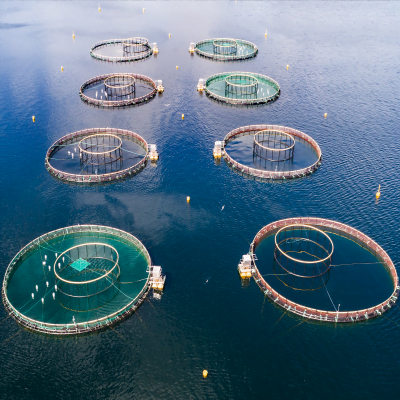
Oyster or mussel farms can lease appropriate waters, purchase juvenile shellfish, maintain cultivation gear and harvest after a growing period. Pond farms stock fish and manage feed and water quality. Flow-through systems rely on ongoing water supply; recirculating aquaculture systems rely on pumps, filtration, oxygenation and power. Offshore net pens require specialized anchoring, vessel access and monitoring.
These systems differ in upfront cost and resilience. A low-maintenance shellfish farm may spend less on feed but face storms and contamination closures. A controlled indoor farm may manage water quality more closely but face electricity, machinery and staffing costs. A business plan should compare whole-life costs, not simply the advertised price of a tank or cage.
Customers, pricing and distribution
Possible customers include processors, seafood dealers, distributors, supermarkets, restaurant suppliers and direct consumers where permitted. Farmers usually receive a farm-gate price that is lower than final restaurant or retail prices. Grading, packing, transport, cold-chain management, spoilage and wholesaler margins absorb part of the ultimate consumer dollar.
A pricing plan should state the unit: live weight, dressed weight, kilograms of edible meat, dozens of oysters, or another market convention. It should also distinguish harvested output from marketable output. A small gain in survival or grading can have a larger effect on earnings than an increase in posted selling price.
Startup planning and permissions
The founder must investigate site or water tenure, species and seed availability, water quality, ecological conditions, vessel or shore access, labor, processing arrangements, biosecurity and the availability of buyers. In the United States, oversight can involve state agencies and multiple federal authorities. Rules for farms vary by water body, species, discharge and processing method.
The Environmental Protection Agency describes federal effluent rules for certain large concentrated aquatic animal production facilities using flow-through, recirculating or net-pen systems that discharge wastewater and produce at least 100,000 pounds annually. Smaller facilities may still have other discharge-permit obligations. These thresholds are not a universal safe harbor. EPA aquaculture effluent guidelines.
NOAA’s aquaculture planning work illustrates why siting is complicated: available water, ecological effects, navigation and other maritime uses must be studied. A designation of a potential aquaculture area does not itself authorize a particular project. NOAA Southern California aquaculture opportunity areas.
Biological economics: feed, survival and time
Finfish production often depends heavily on feed-conversion efficiency. The feed conversion ratio (FCR) is the quantity of feed supplied divided by biomass gained over a defined period. If an illustrative farm buys 140,000 kg of feed and gains 100,000 kg of fish weight, its apparent FCR is 1.4. This simplified ratio does not separately account for mortalities, uneaten feed or all measurement conventions.
Profitability depends on stocking cost, growth time, harvest weight, survival, feed cost, wages, power, oxygen, health management, equipment upkeep and selling price. A production batch may absorb cash for months before earning sales. That timing makes working capital and liquidity especially important in a farming business.
Worked example: a hypothetical fish farm
This is an educational example, not a USDA industry average or investment recommendation. Assume a farm sells 100,000 kg of marketable fish per year at $6.00 per kilogram. Revenue would be $600,000. Assume feed and juvenile fish cost $225,000; production labor $110,000; power, water and routine maintenance $60,000; harvesting, packing and delivery $45,000; site, insurance and administration $55,000. Total illustrative operating expenses are $495,000, leaving $105,000 before depreciation, interest and income tax.
If the founder borrows to build a $650,000 facility, cash interest and principal payments must be financed separately from accounting expenses. For illustration, annual debt payments of $70,000 would leave $35,000 before taxes, major capital replacements and working-capital changes. This $35,000 is not net profit: principal repayment is a cash outflow rather than an income-statement expense, and depreciation has not been included in the simplified operating result.
At a sale price of $5.50/kg rather than $6.00/kg, annual sales drop by $50,000, leaving only $55,000 before depreciation, financing and tax. If marketable yield falls to 85,000 kg at $6.00/kg while modeled costs stay unchanged, revenue drops to $510,000 and operating surplus falls to $15,000. Biology and market price jointly determine the financial result.
Break-even and cash flow
A simplified average-cost calculation divides total annual operating expenses ($495,000) by volume sold (100,000 kg), producing $4.95/kg. That is an operating-cost recovery price under this model, before debt service and omitted accounting costs. It should not be confused with a lender’s full break-even price or a return-on-investment threshold.
A full model must allocate costs by batch, account for fish that die or fail grading, consider inventory changes, seasonal shipment delays, and model the cash held in animals that cannot yet be sold. The article on Revenue, Expenses, and Profit explains why a profitable harvest does not necessarily imply that cash will be available when bills come due.
Operational risks and quality control
Disease, severe weather, low oxygen, water contamination, unexpected power failures, feed price spikes, transport breakdowns and market closures can all disrupt production. Recordkeeping should cover stocking, feeding, deaths, growth, water conditions, treatments, sales and traceability. Insurance may reduce some financial exposures but usually cannot eliminate all operational losses.
Food handling, refrigeration and appropriate processing controls protect marketability and customers. Shellfish and finfish operations face distinct safety risks, so buyers’ quality standards and the governing jurisdiction should shape the operation from its earliest design.
Scaling a viable business
An owner should validate a small production cycle before multiplying volume. More tanks or cages do not automatically create proportional profit: labor skills, feed supply, water capacity, permits, processing, customer demand and transport can become bottlenecks. Expansion can also magnify biological risk when many cohorts share the same water system.
Potential upgrades include better survival, improved grading, direct buyer contracts, dependable cold chain, more efficient feed use, and diversification across products. The central lesson is to prove unit economics and cash conversion before committing capital to a larger facility. The Starting a Business lesson offers a broader planning framework.
Sources and further reading
USDA NASS, 2023 Census of Aquaculture news release — Published December 16, 2024; 2023 U.S. farms, sales, species group totals.
USDA ERS, Aquaculture sector review — Context and inflation-adjusted interpretation of 2023 census.
NOAA Fisheries, Fisheries of the United States — 2024 marine/freshwater aquaculture volume and value estimates.
EPA, Aquaculture Effluent Guidelines — Regulatory scope and permit guidance.
NOAA, Aquaculture Opportunity Areas — Example of regulatory and ecological site-review process.
Class dismissed
The lesson ends here; the wider Centiki world continues beyond the classroom. Explore the fictional economic simulation at Centiki Exchange, follow the labyrinth trail at Centiki.com, or discover the imagined society of the State of Felicia. These are fictional environments, not substitutes for real professional advice or investment opportunities.