Mineral Mining Business: How Extraction, Processing and Sales Work
A mineral mining business turns an identified mineral deposit into a saleable commodity. The apparent simplicity hides a chain of decisions: does the ground contain a commercially valuable mineral, can the material be extracted and processed economically, will buyers pay enough for it, and can the operation be financed and permitted? Centiki Minerals is a fictional company through which we examine these real business mechanics.
What is the product: ore, concentrate or finished industrial mineral?
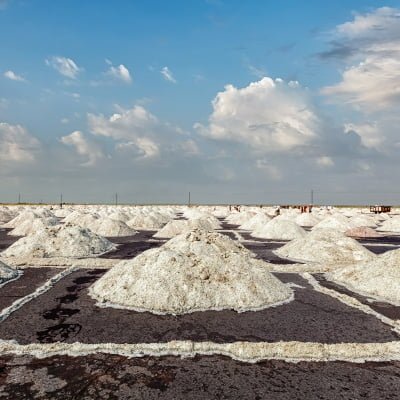
A mine does not necessarily sell pure metal. A copper operation might sell concentrate to a smelter. A quarry might sell graded crushed stone directly to construction customers. A salt operation may sell bulk industrial salt; some deposits can be exploited by evaporation, while others require mechanical extraction. The product specification determines customers, equipment and processing costs. Grade measures the concentration of the desired mineral in the material; recovery measures what fraction of that mineral processing actually captures. Both belong in a feasibility model.
The U.S. Geological Survey 2026 Mineral Commodity Summaries estimates that U.S. nonfuel mineral production was worth $112 billion in 2025. Of that, industrial minerals represented approximately $73.7 billion and metals $38.1 billion. Natural construction aggregates alone accounted for about $39.4 billion. These are national production values, not revenue or profit projections for one mine. The figures demonstrate why “mining” is not one market: a local aggregate quarry and a precious-metals producer face different prices, customers and risks.
Choose the business model before choosing a deposit
There are several ways to participate. A mine owner controls a deposit and pays for exploration, engineering, permits and extraction. A contract miner provides equipment and labor to an owner for a fee. A processor buys raw mineral feed and upgrades it. A mineral distributor buys finished commodities and earns a trading margin. The last two may need far less geological risk than owning a deposit, but have different competitive pressures.
A beginner can study the same mineral market by first analyzing distribution or processing. That does not eliminate working-capital needs. A distributor may have to pay suppliers well before customers settle invoices, and price changes can turn an apparently profitable sale into a loss. For an introduction to financing a new venture, see Starting a Business.
Exploration, geological uncertainty and reserves
Exploration may include geological mapping, sampling, drilling and laboratory assays. A promising sample is not a viable mine. Deposits vary in size, depth, quality, shape and accessibility. Engineers must estimate mineable quantities, dilution, recovery and a production schedule. Investors should distinguish mineral resources, which involve geological estimates, from economically mineable reserves established under an applicable reporting standard. A mine can fail because an accurate ore estimate proves uneconomic at prevailing prices.
The company should develop a staged decision process. Early studies screen geological potential and market access; feasibility studies refine capital and operating estimates; a board makes the investment decision only after reviewing technical and commercial risk. Exploration spending that produces no mine is still a real business expense or investment loss.
Permits, safety and reclamation are costs, not footnotes
Mining rules vary by jurisdiction, mineral, land ownership and extraction method. Operators may face land-use approvals, water and air regulations, reclamation commitments, mineral rights and safety obligations. Requirements cannot be inferred from one national statistic. In the United States the Mine Safety and Health Administration provides operator safety information, while state agencies and other federal agencies may govern particular sites. An environmental consultant and qualified mining engineer are often required before major capital is committed.
A properly developed financial model includes monitoring, maintenance, closure and site restoration. The company must ask what will be owed after the last tonne is sold. Reclamation liabilities and financial assurance can materially affect project value and liquidity.
The commercial calculation: tonnes, grade, yield and delivered price
For a bulk industrial mineral, begin with tonnes sold multiplied by the net realized price per tonne. Deduct extraction, processing, transportation, royalties, administration and sustaining capital. “Net realized” matters because the customer may negotiate freight arrangements, grading adjustments and quality penalties. For metal ores, price formulas can additionally reflect grade, recovery, refining charges and payable metal content.
A mine with high throughput is not automatically profitable. Lower-grade material may require moving and processing more rock per unit of product. Conversely, a small deposit close to a reliable customer may outperform a larger but remote resource. In minerals, geology and logistics share the balance sheet.
Worked example: a small crushed-stone operation
The following teaching example is deliberately hypothetical. It is neither a quotation for equipment nor a representative industry margin. It assumes a permitted operation selling 100,000 tonnes per year at an average net sales price of $19 per tonne.
| Annual calculation | Illustrative amount |
| Saleable tonnes | 100,000 |
| Net sales price | $19/tonne |
| Sales revenue | $1,900,000 |
| Extraction and processing | $9/tonne = $900,000 |
| Outbound freight / handling | $2/tonne = $200,000 |
| Annual fixed cash overhead | $420,000 |
| Cash operating surplus before debt, taxes and capex | $380,000 |
Illustrative teaching scenario, not a reported industry benchmark.
Contribution after the two variable costs is $8 per tonne. At fixed cash overhead of $420,000, the simplified operating break-even volume is 52,500 tonnes ($420,000 divided by $8). This excludes interest, depreciation, income tax, major equipment replacement and reclamation. A lender would also examine debt-service coverage and seasonal cash flow before approving financing.
If volume falls 20%, to 80,000 tonnes, and the same unit economics hold, contribution falls from $800,000 to $640,000. After $420,000 fixed overhead, the surplus falls to $220,000, a reduction of roughly 42%. This is operating leverage: the mine carries expensive fixed infrastructure even when customers buy less.
Capital, working capital and financial discipline
Investments can include mineral rights, exploration, site preparation, excavators, haulage equipment, crushers, processing circuits, utilities and environmental systems. Some equipment may be leased or contracted instead of purchased. The entrepreneur should separate one-time capital expenditure from operating expense and set a schedule for replacements and maintenance. A mine that appears profitable before sustaining capital may consume cash once equipment wears out.
Working capital is also substantial. Payroll, power, fuel and contractors may be paid before customers pay invoices. Inventory can accumulate during weak demand. Compare this with Cash Flow, Working Capital, and Bankruptcy and Capital, Equity, and Commercial Borrowing.
Customers, competition and price volatility
Bulk minerals often compete on delivered cost and consistency. Proximity to customers, rail access, quality assurance and dependable delivery can be more defensible than advertising. Metals may be exposed to internationally traded prices. A sensible plan tests several price scenarios, not only a favorable forecast. The USGS provides commodity-by-commodity data on production, prices, imports and reliance on foreign sources, but it does not guarantee the economics of a particular property.
How to evaluate a prospective mineral company
- Identify the mineral and precise saleable product; never describe a deposit merely as “valuable minerals.”
- Request independent geological evidence, realistic recovery assumptions and a clear production plan.
- Separate operating costs, capital costs, financing costs and closure obligations.
- Validate target customers, product specifications, transport routes and commercial contracts.
- Calculate break-even volume, cash burn and the effect of a material price decline.
For the accounting behind these tests, see Revenue, Expenses, and Profit and Pricing, Competition, and Market Share. The goal is not to find a deposit that looks impressive on a map. It is to identify a lawful, technically feasible operation whose saleable output is worth more than the full cost of producing it.
Sources and further reading
- USGS Mineral Commodity Summaries 2026
- USGS 2026 production-value news release
- USGS mineral commodity data release
- U.S. Mine Safety and Health Administration
Class dismissed
Business economics is the lesson; the wider Centiki world is the playground. For an interactive, fictional exchange where virtual companies and financing can be explored, visit Centiki Exchange. Its ki and shares have no monetary value, are non-redeemable, and confer no ownership or profit rights.
For the trailhead and the playful side of the project, visit Centiki.com. The larger fictional society in which the Exchange ultimately belongs appears at the State of Felicia.
Return to the Business 101 index for more lessons on the economics behind these enterprises.